 Jobzbrv
Workplace life cover is a nice perk, but it has gaps. Here is how to judge whether you need more.
What most employers give
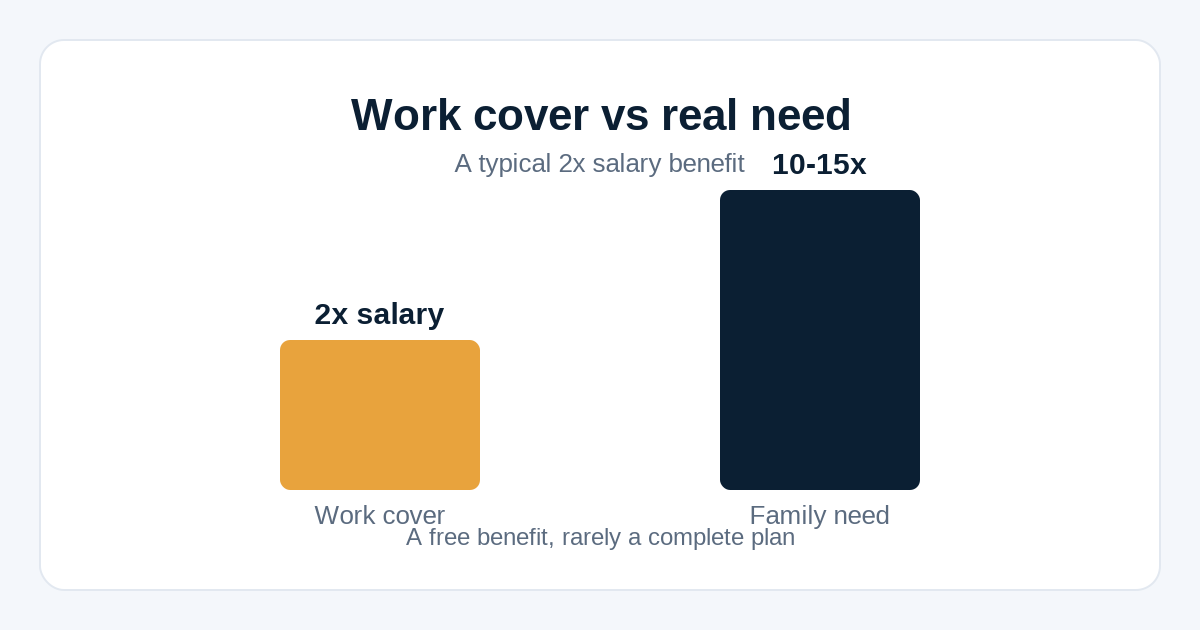
A common benefit is one or two times your yearly salary, at no cost to you. That is a helpful base but rarely a complete plan. If you earn 60,000, a 2x benefit pays 120,000 — which covers two years of income and little else once a mortgage and children enter the picture.
It usually stays with the job
If you resign, are laid off or the company changes providers, the cover can end. Converting it may be possible but can be costly, and there is often a short deadline to decide. Your family's protection should not depend on staying with one employer.
The amount is fixed while life moves
Your family's needs change with every child, loan and pay rise. The workplace amount does not adjust with them. A promotion that doubles your salary does not double the benefit — and a new baby does not increase it at all.
The health factor
Buying your own policy while healthy locks in a price that does not depend on any employer. If you develop a health condition later, the personal policy you bought early is already in force at the healthy rate. Waiting until you need it can mean higher prices or limited options.
A simple plan
Use the How Much Cover calculator, enter your workplace benefit as existing cover and see what is left. Buy that gap as a private term policy — one you own, that follows you between jobs. The Paycheck Replacement Calculator can sanity-check how many years the combined cover lasts.
Keep both
There is no reason to turn down a free benefit. Just do not make it your only protection. Think of workplace cover as the foundation and your personal policy as the house built on it.
Frequently asked questions
How much life insurance do employers usually give?
One to two times salary is common, sometimes more. Check your benefits letter for the exact multiple and any cap.
Can I keep workplace cover if I leave my job?
Sometimes you can convert it to a personal policy, but it is often expensive. Ask HR about conversion rules before you need them.
Should I turn down employer cover?
No. It is usually free. Just do not rely on it as your only protection.
Does employer cover need a medical exam?
Usually not, up to a set limit. That is convenient, but the amount is rarely enough on its own.
How do I find the gap?
Work out your total need, subtract the workplace payout, and cover the rest with a personal term policy.
General information only, not financial or insurance advice.